Parashat Tzav 5783 *sermon delivered at Temple Emanu-El on 3/31/23
Oh, how I long for the Torah portions of Exodus! Exodus holds the majesty of revelation and drama of liberation, the birth of our people. Exodus holds the foundational story we will recall on Wednesday and Thursday evenings at our Passover tables.
We’ve just begun Leviticus, now into our second portion called Tzav, and I’m tempted to just skip over all the flesh, guts, and innards. Smoke, blood and sweat. Leviticus is messy.
And yet, it is precisely in these moments of Levitical protest, I recall a moment which occurred twenty years ago. One of my teachers from Hebrew College, Rabbi Nehemia Polen, led us through a memorable lesson. He invited us to count the pages of our Chumash, the Five Books of Moses, from beginning to end, from Genesis to Deuteronomy. He then asked us to divide the total in half so we could locate the exact middle of the Five Books. Lo and behold, we found ourselves amidst the Book of Leviticus, around this week’s Torah portion, the very center. Leviticus is the beating heart of Torah, Rabbi Polen explained, the embodiment of holiness, the focal point of day-to-day cultivation of our relationship with each other and with the Divine.
Truth be told, I am struggling with Leviticus this year because it is hits so close to home. Flesh and innards, all the messiness, has been quite personal for me this past month. At the start of March, I was diagnosed with breast cancer. Since then, I’ve had scans and tests, sat with startling fear, and stubborn faith.
The first step is surgery on April 21st. And at this stage of the journey, I am relieved to say I feel a sense of comfort, with the pieces of a plan coming together, and knowing at every turn, there is heartfelt care and concern in this narrow place. A very wise friend, who has been on this path before, said, “try not to get ahead of yourself.” That’s been one of the hardest parts of these past few weeks. As many of you know quite well from personal experience, or through the trembling that comes when loved ones face such realities, the practice of staying present is hard in the best of times. It’s spiritual boot camp when the mind can boomerang in the face of illness.
I am choosing to speak directly with you, my beloved Temple community, from this bima tonight, because you are such a significant part of the beating heart of my life, and the life of my family. What I can tell you is that I am, thank God, expecting to be fine. I am relieved to share the long-term view that it’s treatable (I’ve even heard doctors use the word curable), and we are optimistic that after surgery, and likely treatment, I’ll kick this to the curb! While it’s going to be tough in the short term, I believe there is light and healing ahead.
Speaking of light, last Shabbat was magnificent. The Light Years art festival, in collaboration with AURORA, a Dallas public arts organization, unfolded with wonder and depth on our Temple campus. No doubt, it will be an experience we hold communally and individually for years to come. A huge thank you to all the lay leaders, staff and artists who invested countless hours into the creation of Light Years.
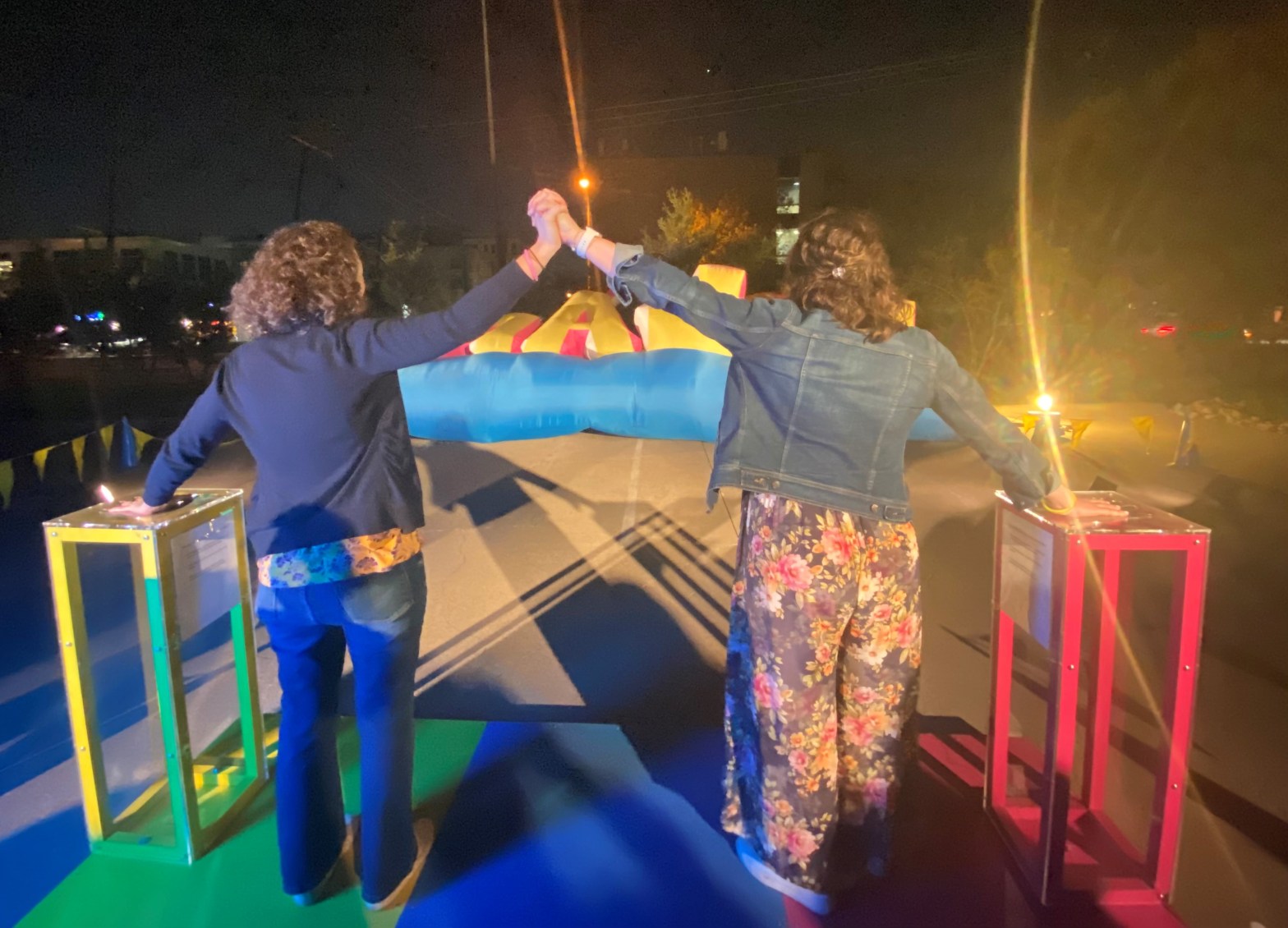
I am treasuring a particular Light Years moment in my heart. I stood with a friend, holding hands, before the “You Are Magic” installation by Alicia Eggert. The inflatable sculpture activated by handprint sensors rose into the words “you are magic” when the warmth from hands circulated from one person to the next. It highlighted for us the ways, hand to hand, face to face, Zoom room to Zoom room, we can activate strength, and courage, and spirit. When we recognize and cultivate the strands of connection that make us a Temple community, the beating heart of our Torah, becomes a living, eternal force, and in a sense, that is a kind of sacred magic.
Over the coming months, there will be periods of time when I will be on medical leave. I will be using the sabbatical blog I created a few years ago, to post some reflections and updates here and there. The link will be included on my away message and on my Facebook page. Most especially, more than anything technical or tangible, prayers for healing we practice daily and weekly, and in all seasons of our lives, are the warmth that can buoy us through valleys and shadows, like hands linked together in an electric current of light. I offer my heartfelt gratitude to you for the support and space to heal, for your prayers and for the immeasurable ways you support this sacred home we share, Emanu-El, day in and day out.
I’ve returned with greater frequency to several favorite poems and meditative Jewish musical pieces, all helpful anchors along the way. One poem I’ve held close is called It Is I Who Must Begin by former Czech president, Vaclav Havel:
It is I who must begin.
Once I begin, once I try –
here and now,
right where I am,
not excusing myself
by saying that things
would be easier elsewhere,
without grand speeches and
ostentatious gestures,
but all the more persistently
– to live in harmony
with the “voice of Being,” as I
understand it within myself
– as soon as I begin that,
I suddenly discover,
to my surprise, that
I am neither the only one,
nor the first,
not the most important one
to have set out
upon that road.
Whether all is really lost
or not depends entirely on
whether or not I am lost.
(Vaclav Havel)
Perhaps Havel was inspired by various Scriptural references when he composed this piece. He speaks directly to those moments when we might feel the darkness of despair, when we are unsure if we will find the road home. And yet, he writes, a “voice of Being” is there all along, steering us back, guiding our steps. So too, our Torah portion reminds us there is always a light that can illumine the way.
At the very beginning of Parashat Tzav we read:…the fire on the altar shall be kept burning, not to go out…a perpetual fire, an aish tamid, shall be kept burning on the altar, not to go out (Leviticus 6:5-6).
The phrase “not to go out” is repeated twice, perhaps because this was a challenging task, thus requiring even greater intension and focus. Or, drawing from a teaching of the Sefat Emet, the repetition “not go out” signifies different kinds of fires, the physical one, like the ner tamid, the eternal light above me here in Stern Chapel and the spiritual one.
The Sefat Emet writes:
“In the soul of every [human] there lies a hidden point that is aflame with love of God, a fire that cannot be put out. But the human longing to worship the Creator must be renewed each day, as we read: The priest shall burn wood upon it each morning.”
In the dawn of morning, in the waning sunlight of the afternoon, and under the night sky, there is a fire that burns eternally, like a steady, perpetual heartbeat that fuels our connection to the Divine over time and space.
It takes work, it takes courage, it takes patience, and it takes lifting our voices in song. May we discover anew our strength, again and again, through reaching out to each other and to God. Ozi v’Zimrat Yah Vayahi li lishuah, the Psalmist proclaims, My strength (balanced) with the Song of God will be my salvation.
 Reflections by Rabbi Kim
Rabbi Kim, several years ago when I had an unwelcome diagnosis, I realized that we come from very strong forebears. Our forebears survived Egypt, years in the desert, displacement, pogroms, and centuries later, pure evil. Yet here we are, the children of the strongest of those foremothers. We are tough, and we are survivors. What brought this realization to me was Debbie Friedman’s beautiful “Mi Shebeirach.” I played it over and over. Listening to it, I never doubted a complete recovery. With your endless resources, I hope you will find something as reassuring so you can proceed through your journey with complete confidence that someday you will say, “many, many years ago when I was ill ……”
LikeLike