Dawn

It’s dark outside, just before 5am. I’ve been trying to sleep for the past hour but the steroids from yesterday’s infusion are making that challenging. I have now officially begun phase 2 of chemo, which entail weekly infusions — and if all goes well with my ability to tolerate the frequency and amount, I will, God willing, be ringing that bell marking the conclusion of chemo the week of Yom Kippur.

Each person who makes her or his way through life’s challenges and joys finds language that resonates, language that hopefully helps hold the daily work of healing; the daily work of finding his or her compass. For me, the word “journey” is resonant again and again for physical and spiritual realities, and perhaps most powerfully for what I am experiencing these days (I admit, it’s easy to overuse the word “journey” in writing and speaking but I still love it!).

This Shabbat we conclude the Book of Numbers with the double parashiot, Mattot-Masei.  The last chapter of Numbers begins with a retelling of the journey from Egypt to the banks of the Jordan River.  The Israelites stand ready to enter into the Land of Israel, but before they do, they take a moment to remember from where they have come, step by step. 42 stops in total.

I am sure it could be monotonous in the desert. Just another day to pitch the tent. Another day of body aches. Just another sky full of stars. Another sunrise. Or…

There is a community surrounding me–we can help pitch our tents together! This body is weary–and I don’t want to fight against the weariness. I feel all these physical sensations, as my breath is restored each morning. Thank God for the ground that meets my feet as I set out, resting as I can, for that is part of the sacred work of healing. Amidst the uncertainties of night’s descent, the stars and the emerging dawn bring the flicker of hope.

It’s hard to stop and notice, as routines can cover our eyes.  It’s hard to open our hearts to daily wonders when our spirits are broken, our hearts embittered. It’s hard to feel gratitude for the simplicity of a steaming cup of tea in our hand when the journey feels endless and the worries a heavy burden.

It is hard, and yet, the sun rises each day and Shabbat returns with whispers of a wisdom that has carried us for 42 stops and beyond. We can find our compass while we journey forth, for it has always been there in our hands if we but pause long and deep enough to see it. We are invited to remove our hands before our eyes and look out, and look within. 

Pat Schneider captures this beautifully in the poem, The Patience of Ordinary Things:

It is a kind of love, is it not?

How the cup holds the tea,

How the chair stands sturdy and foursquare,

How the floor received the bottom of shoes

Or toes. How soles of feet know

Where they’re supposed to be.

I’ve been thinking about the patience

Of ordinary things,

how clothes

Wait respectfully in closets

And soap dries quietly in the dish,

And towels drink the wet

From the skin of the back.

And the lovely repetition of stairs.

And what is more generous than a window?

Thank you for journeying with me, friends. To many more stops together, from dawn to dusk, discovering the extraordinary in the ordinary miracles of today.

Opening the Door

*abridged sermon, Parashat Korach June 23, 2023/4 Tamuz 5783

In the days leading up to our children’s departure for sleepaway camp, the first summer they’ve been away for such a length of time, there were a series of minor rebellions. A particular one I won’t forget went like this:

Amidst the natural nerves of delving in to such a new experience, one of the kiddos said: “What if I just don’t get in the car?” I replied with understanding, remembering well the many emotions I felt at their age leaving for sleepaway camp: “Well, that’s not an option, and your feelings of nervousness and fear are totally normal. Let’s talk about what you can choose—like, the attitude you bring to a new experience.” I count that as a good parenting moment. Believe me, there are plenty of others when I’ve said: “Just get in the car.”

I’m relieved to share the very same kiddo that proposed she might ground her feet at home, helped load up the duffle bags and is making her way through the mystery and magic of Jewish sleepaway camp.

Amidst trying to process the feelings of launching our children forward into one of the most impactful opportunities in their Jewish and personal growth, I’ve realized a few things. We humans can quickly judge what we don’t know or understand. There are times we even shut the door and close ourselves off from experiences that can potentially be transformational. We learn to evolve with our judgement and many of us, really all of us, also hold fast to our judgement well into adulthood, like the main character of this week’s Torah portion, Korach.

In Parashat Korach, God again strikes a portion of the Israelites down after a rebellion grows to 250 people. Born out of the fear and uncertainty that arose from a recent report of the Promised Land which described giants and certain death, this rebellion causes a great rift in the community. It begins with “Vayikach Korach”—”Korach took.” We soon learn that, although he claims to advocate on behalf of the people, Korach has a growing hunger for power. Korach took—he seized hold of leadership with force.

Korach’s specific claim against Moses and Aaron is the following: You have gone too far! For all the community are holy, all of them, and God is in their midst. Why then do you raise yourselves above God’s congregation?  Korach has a very valid point, a compelling claim. I am sure there were moments when Moses and Aaron failed to see the holiness surrounding them among their people. I am sure there were moments calling out for teshuva, for all need to be held to account, including the highest level of leadership.

However, what Korach failed to do was check his own sense of judgement. What if he took his valid concerns and approached Moses and Aaron with a sense of relationship and responsibility for their roles in the greater community? What if he realized there were certain realities unknown to him and approached with more curiosity instead of leading with a foregone conclusion?

Like Korach, judgement can enter our hearts and minds, at times roaring so fiercely. Other times it creeps stealthily, so we hardly know it’s there. Judgement can enter our hearts and minds, instilled from an early age, living and preying on insecurities, lack of control, and pain. Since judgement is such a powerful shaper of the human psyche, it comes as no surprise that it rears its head so often in the desert wilderness, the setting for much of the Five Books of Moses.  In the wilderness, judgement finds its breeding ground. As we travel through the Book of Numbers, deep in the heart of the wilderness, the sense of judgement that emerges from the Israelite community in these parshiot is reflected in our own as we wrestle within the barrage of realities that fill our daily lives.

Judgement is often shaped by messages we receive from the world around us. I’ve become aware of this when I struggle with the language we often use for cancer. Like the poster hanging in my doctor’s office with a man, arms folded across his chest and below him are the words “Fight Cancer.” I am battling breast cancer. Yes. And there is no doubt I want to beat the (beep) out of it. But what if, on a given day, I’m not feeling like a warrior, and instead, feel more like a yoga student. What if I am also learning to breathe with cancer treatment? The language of going to battle is itself a kind of judgement, and yet my movement on this path thus far is multi-dimensional. I need to draw on my fiery, warrior spirit, yes, but also the spirit of a gentle breeze and cooling waters. And what about God in all this?  As a faithful person, when doubt and fear rear their head, do I become more like a rebellious Korach than a steadfast Moses? Judgment makes its way into my thoughts like a buzzing mosquito in an unrelenting Dallas summer.

I recently read a short essay by writer Brian Doyle, may his memory be for blessing, who said: “For all that we speak, as a culture and a people, of victory and defeat, of good and evil, of hero and coward, it is none of it quite true. The truth is that the greatest victory is to endure with grace and humor, to stay in the game, to achieve humility.”

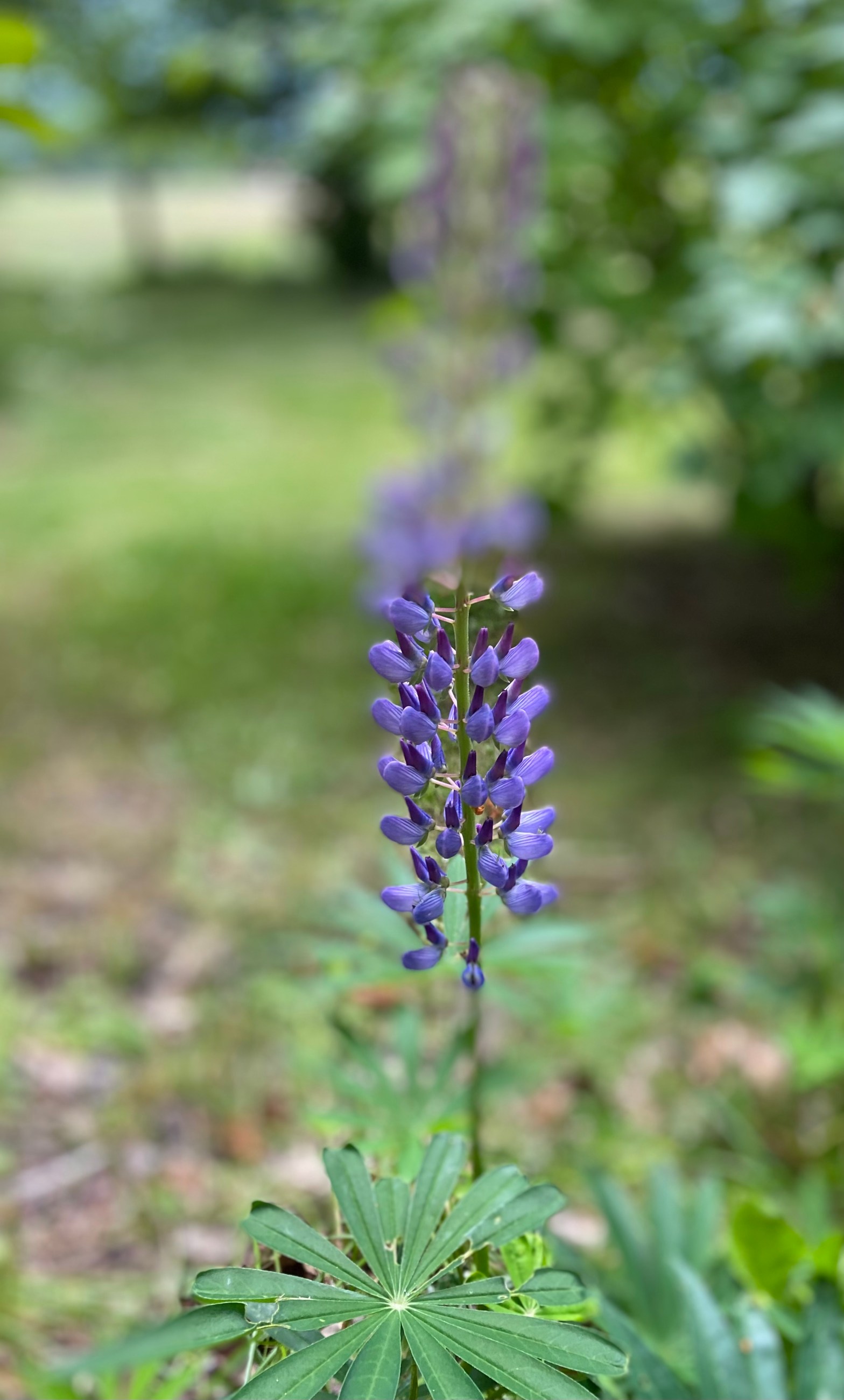
Amidst weariness and fear, there is victory in patiently enduring while savoring the ordinary moments of blessing. I pause and breathe, when the melodies of Shabbat return and my soul sings, when a vibrant flower in the backyard blooms with abandon. I remember to release the judgement and hear again an inner voice born from our Rock and Redeemer, a still small whisper that always returns. Like a little girl within a judging world, hauling those bags into the back of the minivan, heart aflutter, opening the door to new dimensions of strength, and love, and hope.

Lifted Up

*sermon for Shabbat Be’ha’alotecha, delivered June 9th, 2023

On this Shabbat, as we so often do, I want to begin with gratitude.

Since I shared with you at the end of March that I am undergoing breast cancer treatment, my family has been held with such loving care. The notes, the delicious meals and offers to help with the kids and the dog, the space for healing and the ongoing compassion—each gesture makes such a difference. Thank you.

I am hopeful that, as summer continues, I will work as I am able in a part-time capacity. My ability to respond and be present will be determined by the ebb and flow of chemo. I want to offer special thanks to the exceptional Temple clergy, staff and lay leaders for their support–what a blessing to be part of such a team that works together to make Temple the sacred heartbeat of so many lives.

And I am grateful for Torah, this precious gift we received just two weeks ago on Shavuot, the holiday marking the moment, and ongoing moments, of receiving Torah at Mt.Sinai. Through the lens of Torah, we can find meaning as we walk the narrow path of fear. Through the turning of pages and time, we can feel held by a greater tapestry, a majestic and awesome force, woven by our ancestors and now in our hands to carry forth.

And through everyday living, we can discover Torah anew in the smaller, ordinary occurrences. It is so comforting to know that the smell of lavender awakens calm, that the light of the sun on my face tingles my skin, that a song about sister’s rising with courage can open a flood of tears. Strength accompanies spiritual exhaustion when circles of care and prayer remind is that we are not alone. This is the gift of Torah that can keep us steady and lift us up.

Speaking of lifting up, Parashat Be’ha’alotecha begins with instructions for the ritual of lighting the seven lights of the menorah in the Tabernacle. The verb describing the actual act of lighting is be’ha’alotecha, the name of this portion, which we can translate as “to lift, to ascend, to raise up.” The opening verse reads: “When you raise up the lamps, let the seven lamps give light at the front of the lampstand.”

I think most of us refer to the lighting of candles as l’hadlik ner, which we did this evening at the start of the service, to kindle lights of Shabbat or holidays.

Why in this week’s Torah portion do we say raise up the lamps?

What makes the lighting in this portion distinct?

Well, for one, if I were to light the menorah in Stern Chapel, I would need to ascend a ladder to reach the candles. The ascending of the light describes the work of raising oneself up to reach the lamps of the menorah. The specific language used in our Torah portion is a reminder that the details, the logistics and building blocks of our work, that enable our individual and collective lives to function, and hopefully flourish, can be holy.

It reminds me of a favorite Marge Piercy poem, entitled To Be of Use:

The people I love the best

jump into work head first

without dallying in the shallows

and swim off with sure strokes almost out of sight.

They seem to become natives of that element,

the black sleek heads of seals

bouncing like half-submerged balls.

I love people who harness themselves, an ox to a heavy cart,

who pull like water buffalo, with massive patience,

who strain in the mud and the muck to move things forward,

who do what has to be done, again and again.

I want to be with people who submerge

in the task, who go into the fields to harvest

and work in a row and pass the bags along,

who are not parlor generals and field deserters

but move in a common rhythm

when the food must come in or the fire be put out.

The work of the world is common as mud.

Botched, it smears the hands, crumbles to dust.

But the thing worth doing well done

has a shape that satisfies, clean and evident.

Greek amphoras for wine or oil,

Hopi vases that held corn, are put in museums

but you know they were made to be used.

The pitcher cries for water to carry

and a person for work that is real.

I have a new appreciation for the logistics that define medical care, the layered details attended to by nurses and surgeons, PT specialists and oncologists. I am lifted to the hope of greater health and healing because I have insurance, and an excellent team helping guide me with each step. Everyone deserves access to such care, to ease of logistical support. We need ladders to climb and matches set on the table, teams of priests and poets, doctors and drivers, all lifting up the light through “work that is real.”

However, we know the language of Beha’alotcha reflects something in addition to logistics, as we aspire to make our spiritual life expand beyond nuts and bolts, wicks and matches.  As we say in Psalm 18:29: “It is You who light up my light; the Lord, who lights up my darkness.” The power of rituals and prayers, lighting the menorah lamps, caring for those in need, studying Torah on a Shabbat morning—all of this and so much more—are reminders of our partnership with a God who can illuminate our days.

I have experienced more personally over these past few months the power of prayers as a source of healing. What light can emerge within the darkness of pain and fear. I’ve been participating in Shabbat services online and as I offer names of those who are ill, I have heard my own blend into the sacred cacophony before we sing Mi Sheberach. Our singing bridges a connection, near and far, in heart and hope.

It seems a bit serendipitous that this week’s Torah portion includes Miriam’s illness and the prayer offered by Moses, El Na Rafanah Lah. “Please God Heal her.” I imagine Moses offers this brief prayer as a kind of primal cry, with a sense of overwhelm, reaching out beyond himself to the Healer of the Broken Hearted. Miriam is the healer, the one who holds nourishing waters for her people, the dancer and singer on the shores of the sea. And yet, even she can be touched by fragility, and even she can be held by the prayers of her people, lifted up to discover renewed courage. Lifted up like the flames dancing in the lamps of the menorah. Lifted up like the pillar of cloud and fire that manifests each day and night as God leads the people through the wilderness.

As we make our way through the Book of Numbers, called in Hebrew “Bamidbar” —“in the wilderness”, I have new appreciation for what it must have been like for our ancestors to discover the light of such rituals and the wisdom of Torah.  We know there were moments the Israelites looked back longingly on the past before they met the desert expanse, and yet, time and again, they learn that if they keep working towards a greater good, if they keep trying to cultivate a steady faith, if they keep believing that the light of hope can pierce through the darkest days and lift their sights, it is possible to not only survive, but to thrive. Despite how harsh the wilderness can be, it is in many ways like a cocoon, a place of tremendous transformation where the Israelites wrestle with fundamental truths as they prepare to spread their wings of freedom.

Their journey is ours.

In its essence, at its root, midbar is the stuff, the things, the words, the morrow of life. Wilderness may be disorienting and foreign, but I believe it’s also made of all that we need to become, as the revelations of life keep unfolding. Through pain and fear, may we make our way to health and light, to dance anew. Shabbat Shalom!

Beauty

This past Shabbat we read from Parashat Naso. In the portion there are laws detailing the custom of a Nazarite, an Israelite who takes on specific vows. For example, a Nazarite abstains from cutting his hair, and it is this particular vow that stood out for me. In contrast to the Nazir, I’ve been preparing to loose my hair.

For the kids, this has been a touch point of concern and angst. Initially, I was neutral about the whole reality. It’s only hair. But now, as more hair falls, I realize there resides within me complex emotions. Over time, I’ve come to love my curly hair. As a child, my hair was often an unruly frizz ball and I longed for straight hair that would effortlessly blow in the wind. It wasn’t until later that I learned to style and care for curly hair. I still have my moments of exasperation in the Dallas humidity, or when I’m overdue for a cut, but on the whole, it’s become part of my identity. Part of how I feel beautiful.

And then…I remember the people I’ve known with alopecia, or who have lost hair due to cancer treatment. Their beauty shines so vibrantly in my mind’s eye. And then…I remember the aspect of Tiferet in Jewish mystical tradition, which we can translate as “beauty”, however, it is so much more than physical appearance. Tiferet is the way we balance, the way we discover harmony, between our compassion and our judgement. Whatever I will look like in the coming months, how can I bring greater compassion and less judgement to my outward appearance? How can I, perhaps, embrace this as an opportunity to expand my sense of inner and outer beauty, all one in God’s eyes?

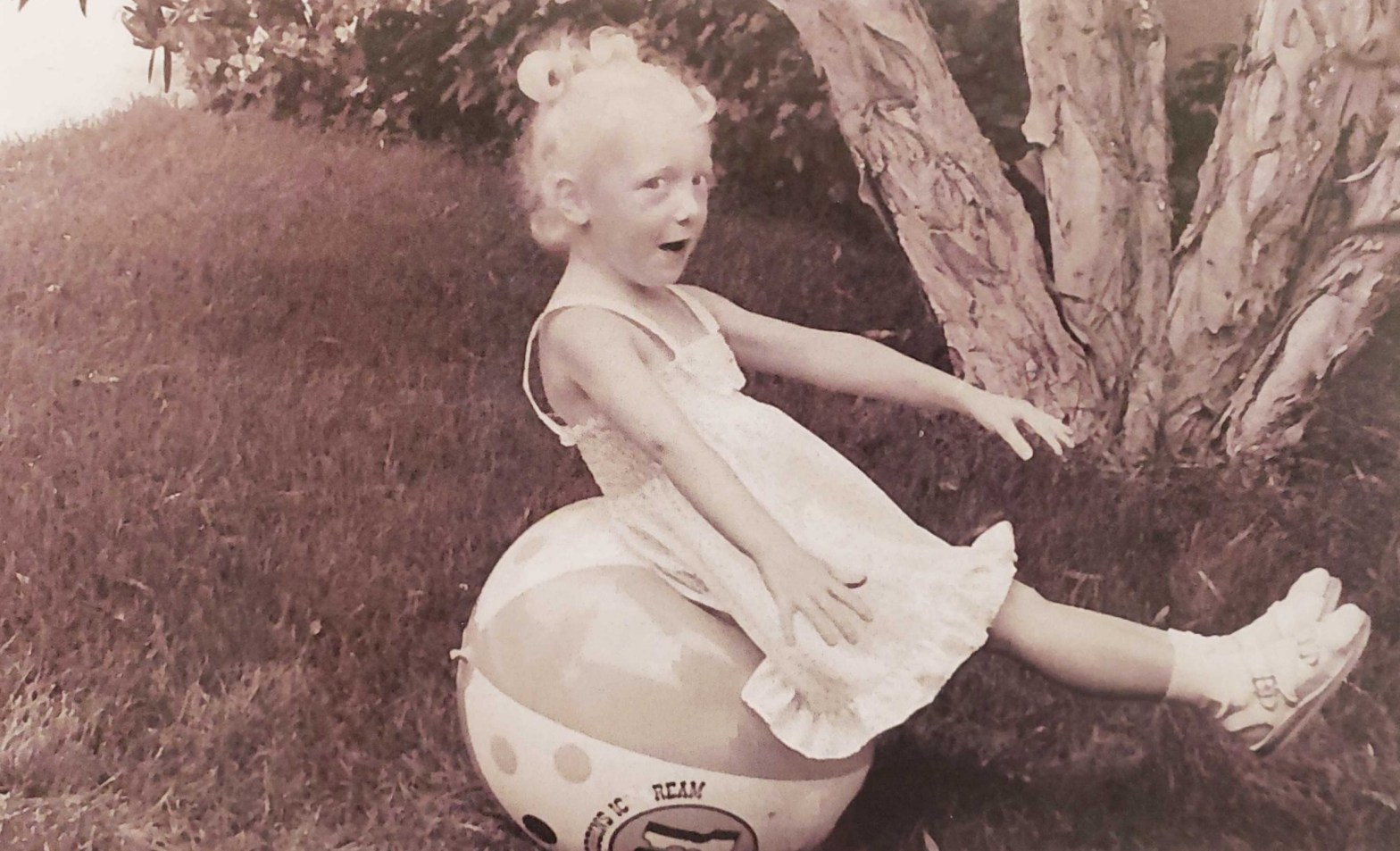
I am reminded of a picture my grandfather took, now almost 40 years ago. I can still remember the smell of the ocean air, the warmth of the California sun, the delight in exploring their La Jolla backyard and patio with it’s treasures. Balancing on a ball, my expression shows both delight and some trepidation that I might fall. But the love keeps me steady. The miracle that we are here at all holds the mind, body and soul in balance. The wonder and hope of what is yet to come is a kind of beauty, more precious than any strand of hair.

Details

When the Israelites received Torah at Sinai, a moment we will celebrate this Thursday evening and Friday with the holiday of Shavuot, the gift of Torah included everything—the prose and poetry, the minutia descriptions, and the seemingly mundane details.

It occurred to me today that I haven’t included in any of my reflections the details of my diagnosis. It was clear to me from the start I wanted to bring you—friends, family and community—with me in some way because all y’all (as we say in TX) continue to be an extraordinary source of spiritual energy and because writing is a source of healing for my heart and mind. Less clear—when I would have the inclination to share details. So in celebration of the full scope of what Torah means in our lives, I am ready to share a few more details. This is also my way to acknowledge that worry might grow when specifics aren’t part of an evolving story, and my prayer that perhaps in sharing, in whatever way each of us may feel comfortable doing so, other’s may learn, as I have from the countless women and men who have been on similar pathways before me.

Breast cancer runs in my family, on both sides. I am not a BRCA carrier, however, a year or two after the twins were born (so about 7 years ago), I started having yearly 3D-mammograms. Often after mammograms, I would go to have a follow up sonogram, all occurring on my left side, and the cysts would come back as normal. They would come and go. I continued having 3D-mammograms through Covid and just last summer, felt a small lump on my right side but the 3D-mammogram came back normal so I figured it would go away. Well, with super dense breast tissue, it isn’t uncommon for mammograms to miss things.

It didn’t go away, and thank goodness, I eventually called a wonderful breast specialist, my doctor, and asked to have another 3D-mammogram and this time with a follow up sonogram. By March 3rd, we discovered that I had invasive ductal carcinoma. After all the imaging and a double mastectomy, my diagnosis is Stage IIa, with the cancer contained in the right breast (no metastasis detected). I do however, have Grade 3, which means fast growing cancer, hence a regimen of chemo required to hopefully clear out any traces of potential micrometastasis. I am ER+ and PR+ (estrogen and progesterone positive), HER2 negative, so I will be taking hormone therapy to help block any future growth. Due to the fact the margins weren’t able to be fully cleared with surgery (cancer cells still in the remaining skin left for reconstruction), I will have targeted radiation to that area after chemo.

There are so many terms that were mysteries to me and countless details I couldn’t make sense of in the initial period of diagnosis. Now, a bit more has settled into these specifics—awe that we have the means and scope to medically discover so much, while there are still always limits to our human endeavors; gratitude that excellent research and support is available for those of us with breast cancer and hope that this will continue for all, facing any kind of cancer; deeper awareness of the fragility of life and the fierce advocates we can be through mind/body attunement, seeking support and asking questions.

Amidst the details, may we all find our own Torah unfolding.

Wilderness

I started chemo the week we began reading the Book of Numbers, called in Hebrew “Bamidbar” — trans, “in the wilderness.”

I have not met a wilderness quite like this. Phase I of chemo will be the most challenging and the time frame runs roughly within this fourth book of Torah, hopefully concluding in early July, a week before the last portions of Bamidbar when we recite the phrase marking the end of a book and the beginning of a new one—“Chazak, chazak v’nitchazek.” Be strong, be strong and may we be strengthened.

How do we find strength in the wilderness? How do I dwell in my body that feels such deep waves of fatigue, it’s as if all my limbs are weighed down by a heavy blanket? The Israelites were well versed in crushing fatigue—they had been slaves in Egypt. The journey through the desert had its physical burdens, different than before, scary and new.

Amidst the physical, the challenge to spiritual endurance seems to be the most defining of the wilderness. As I take each step, as the waves of side effects ebb and change, I pray the return to healing light in my mind and soul pierces through. It is so comforting to know that the smell of lavender awakens calm, that the light of the sun on my face tingles my skin, that a song about sister’s rising with courage can open a flood of tears. Strength accompanies spiritual exhaustion when circles of care and prayer remind me that I am not alone.

I’m reminded of the Joshua trees that would pass in a blur through the car window when we drove through the majestic and haunting Mojave desert. Every car ride of my childhood through the Mojave brought the delight of seeing those trees dance—stubbornly and with dogged spirit. Yes, even in the desert we just might dance. For in its essence, at its root, midbar is the stuff, the things, the words, the morrow of life. Wilderness may be disorienting and foreign, but I believe it’s also made of all that we need to become, as the chapters of life keep unfolding. Through pain and fear, may we make our way to health and light, to dance anew.

A prayer for Ludlow*

*I’ve decided to name my chemo port, which will be “placed” this coming Monday. My port will be named Ludlow. Port Ludlow, WA has been a sacred place for me and my family for two decades. A place of healing, growth, and joy. I pray each drip of the chemo through Ludlow, will “kick cancer to the curb” as I’m often saying, so my future will hold many years of such precious life-affirming memories as we’ve experienced in the Pacific Northwest.

You will be placed on a warm Dallas day with caring hands,

A physical portal of healing.

As the “red devil” drips and the summer temps climb

I will try to open the gates of my mind and soul, envisioning days

Of cool moss laden forests and meandering streams,

Of my hands running over rough bark of that stately Mother Tree.

Yes, I will return!

Return through cold caps and tears and rom-com binges.

I will try to breathe with each heave

Smile with tired eyes at the shouts of water fights in the backyard

And pray that the chemo sap that will infuse its way through you

Will bring me to a future of long Ludlow days

Where the sand is really beneath my feet

and the breeze touches my face as a kiss

Of gratitude

Of wonder

Of peace.

Endurance

Two weeks since surgery. Day 29 of the Omer.

The dimension and practice of endurance (netzach) has taken up residence in my mind and heart this Omer counting season. I’ve always been drawn to movement—water cascading, the surge of social change from those who once considered themselves powerless, the masterminding of complex family/work schedules and, always, the cycles of sacred growth from Jewish living. Push, and do, and strive and delight, let go, build, rebuild, all of it endurance. All of it a part of who I am, who we are, and something to forever cultivate until my/our last breath.

And I’ve come to realize there is no single dimension to endurance. Movement takes many forms and sometimes the most needed kind is found in being the sturdy oak, in allowing a redeeming rock to fit in the palm of the hand. Just like there is no single name for God, there is no single definition to any of these kabbalistic aspects of the Omer that represent a dynamic longing to be at one with the One. Endurance takes pushing with grit and having a clear vision for what it’s all for—and it takes something of the surrender and stillness to just be in what’s true today, Day 29.

I’ve had days of not wanting to do anything but loose myself in a mindless movie or an absorbing novel. Days when I just wanted to exert no effort or think about the stages of treatment ahead. And days of triumph with the smallest step of independence or advocacy for what I need in what can feel like a tangled web of information and appointments. Days when I have felt both within the same hour. Endurance takes some suspension of judgement — judgment of emotions or an imprinted definition of progress. And endurance most definitely takes asking for help along the way.

So on Day 29 which in a few hours will become Day 30 with the gift of Shabbat, I can say that I am enduring. I am looking back with wonder at how my body is healing, trying to garner strength for the beginning of chemo which will start this month, and in this very moment, so deeply grateful for the accompaniment of my/our village of family, friends, neighbors, faith community; for notes and well wishes, stories and songs, nourishment of body and soul. And with each step, movement of water and stone, sadness and hope, surging with tears and steady in love.

Shabbat shalom, dear ones.


Counting Up

Making each day count is a valuable lesson which adopting the practice of counting the Omer reinforces. Counting each of the days of the Omer reminds us that all of our days are numbered, and it is our responsibility to make each day count. The deliberate way in which the Torah numbers the days of Sarah’s life, “one hundred years and twenty years and seven years” signifies both the fullness of her days and the significance of each and every day. We count the Omer in a similarly careful and focused manner in order to help us recognize the completeness of these days and of each day (Carol Ochs).

The counting of the Omer began the second day of Passover. Each evening we offer a blessing and declare the number of days all the way until fifty which marks Shavuot, the sacred occasion when we celebrate receiving the gift of Torah at Mt.Sinai.

We are now on day eleven. And I am four days away from surgery. Time has moved in challenging and mysterious ways over the past month and a half, with excruciating waiting periods, shifts in plans, and yet, all the while a constant drumbeat of a truth–that no matter what season of my life, each day can count. Some seasons reveal this truth with full, raw, vibrancy.

I am drawing comfort in this year’s Omer practice as I count up –not only to days ahead, I pray, when I can thrive amidst the battle to survive, but right now, right here, to live with a sense of wholeness even when I physically experience discomfort, pain and so many new realities.

Each day can count when I pause in the morning darkness to say Modah Ani. Thank you, my Rock, for the foundation of spirit which holds my feet steady as I make my way.

Each day can count when I bury my face in my children’s messy hair before school. Thank you, my Rock, for the resiliency of children that reminds me to focus on what matters most.

Each day can count when I soften fear with compassion for myself and others, reaching out my heart to acknowledge my partner’s open hand. Thank you, my Rock, for the healing power of love.

Each day can count when I feel the expansive circles of prayer and generous care. Thank you, my Rock, for the embrace of friendship, family and community.

May the words of my mouth, the meditations of my heart, the practices which bring mind, body and soul into alignment with You, my Rock and Redeemer, remind me that each day can count.

Currents of Light

Parashat Tzav 5783 *sermon delivered at Temple Emanu-El on 3/31/23

Oh, how I long for the Torah portions of Exodus! Exodus holds the majesty of revelation and drama of liberation, the birth of our people. Exodus holds the foundational story we will recall on Wednesday and Thursday evenings at our Passover tables.

We’ve just begun Leviticus, now into our second portion called Tzav, and I’m tempted to just skip over all the flesh, guts, and innards. Smoke, blood and sweat. Leviticus is messy.

And yet, it is precisely in these moments of Levitical protest, I recall a moment which occurred twenty years ago. One of my teachers from Hebrew College, Rabbi Nehemia Polen, led us through a memorable lesson. He invited us to count the pages of our Chumash, the Five Books of Moses, from beginning to end, from Genesis to Deuteronomy. He then asked us to divide the total in half so we could locate the exact middle of the Five Books. Lo and behold, we found ourselves amidst the Book of Leviticus, around this week’s Torah portion, the very center. Leviticus is the beating heart of Torah, Rabbi Polen explained, the embodiment of holiness, the focal point of day-to-day cultivation of our relationship with each other and with the Divine.

Truth be told, I am struggling with Leviticus this year because it is hits so close to home. Flesh and innards, all the messiness, has been quite personal for me this past month. At the start of March, I was diagnosed with breast cancer. Since then, I’ve had scans and tests, sat with startling fear, and stubborn faith.

The first step is surgery on April 21st. And at this stage of the journey, I am relieved to say I feel a sense of comfort, with the pieces of a plan coming together, and knowing at every turn, there is heartfelt care and concern in this narrow place. A very wise friend, who has been on this path before, said, “try not to get ahead of yourself.” That’s been one of the hardest parts of these past few weeks. As many of you know quite well from personal experience, or through the trembling that comes when loved ones face such realities, the practice of staying present is hard in the best of times. It’s spiritual boot camp when the mind can boomerang in the face of illness.

I am choosing to speak directly with you, my beloved Temple community, from this bima tonight, because you are such a significant part of the beating heart of my life, and the life of my family. What I can tell you is that I am, thank God, expecting to be fine. I am relieved to share the long-term view that it’s treatable (I’ve even heard doctors use the word curable), and we are optimistic that after surgery, and likely treatment, I’ll kick this to the curb!  While it’s going to be tough in the short term, I believe there is light and healing ahead.

Speaking of light, last Shabbat was magnificent. The Light Years art festival, in collaboration with AURORA, a Dallas public arts organization, unfolded with wonder and depth on our Temple campus. No doubt, it will be an experience we hold communally and individually for years to come. A huge thank you to all the lay leaders, staff and artists who invested countless hours into the creation of Light Years.

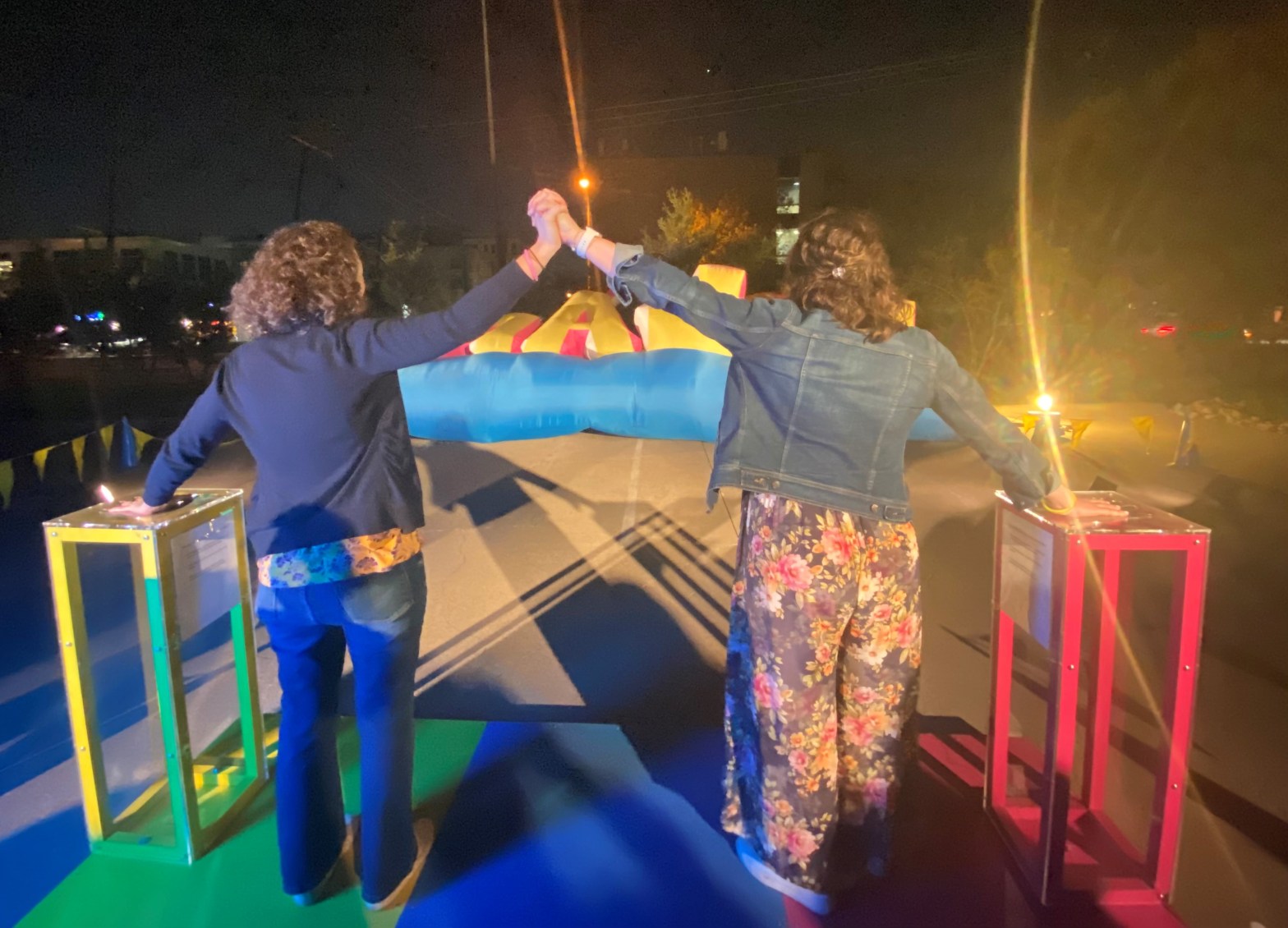
I am treasuring a particular Light Years moment in my heart. I stood with a friend, holding hands, before the “You Are Magic” installation by Alicia Eggert. The inflatable sculpture activated by handprint sensors rose into the words “you are magic” when the warmth from hands circulated from one person to the next. It highlighted for us the ways, hand to hand, face to face, Zoom room to Zoom room, we can activate strength, and courage, and spirit. When we recognize and cultivate the strands of connection that make us a Temple community, the beating heart of our Torah, becomes a living, eternal force, and in a sense, that is a kind of sacred magic.

Over the coming months, there will be periods of time when I will be on medical leave. I will be using the sabbatical blog I created a few years ago, to post some reflections and updates here and there. The link will be included on my away message and on my Facebook page. Most especially, more than anything technical or tangible, prayers for healing we practice daily and weekly, and in all seasons of our lives, are the warmth that can buoy us through valleys and shadows, like hands linked together in an electric current of light. I offer my heartfelt gratitude to you for the support and space to heal, for your prayers and for the immeasurable ways you support this sacred home we share, Emanu-El, day in and day out.

I’ve returned with greater frequency to several favorite poems and meditative Jewish musical pieces, all helpful anchors along the way. One poem I’ve held close is called It Is I Who Must Begin by former Czech president, Vaclav Havel:

It is I who must begin.

Once I begin, once I try –

here and now,

right where I am,

not excusing myself

by saying that things

would be easier elsewhere,

without grand speeches and

ostentatious gestures,

but all the more persistently

– to live in harmony

with the “voice of Being,” as I

understand it within myself

– as soon as I begin that,

I suddenly discover,

to my surprise, that

I am neither the only one,

nor the first,

not the most important one

to have set out

upon that road.

Whether all is really lost

or not depends entirely on

whether or not I am lost.

(Vaclav Havel)

Perhaps Havel was inspired by various Scriptural references when he composed this piece. He speaks directly to those moments when we might feel the darkness of despair, when we are unsure if we will find the road home. And yet, he writes, a “voice of Being” is there all along, steering us back, guiding our steps. So too, our Torah portion reminds us there is always a light that can illumine the way.

At the very beginning of Parashat Tzav we read:…the fire on the altar shall be kept burning, not to go out…a perpetual fire, an aish tamid, shall be kept burning on the altar, not to go out (Leviticus 6:5-6).

The phrase “not to go out” is repeated twice, perhaps because this was a challenging task, thus requiring even greater intension and focus. Or, drawing from a teaching of the Sefat Emet, the repetition “not go out” signifies different kinds of fires, the physical one, like the ner tamid, the eternal light above me here in Stern Chapel and the spiritual one.

The Sefat Emet writes:

“In the soul of every [human] there lies a hidden point that is aflame with love of God, a fire that cannot be put out. But the human longing to worship the Creator must be renewed each day, as we read: The priest shall burn wood upon it each morning.”

In the dawn of morning, in the waning sunlight of the afternoon, and under the night sky, there is a fire that burns eternally, like a steady, perpetual heartbeat that fuels our connection to the Divine over time and space.

It takes work, it takes courage, it takes patience, and it takes lifting our voices in song. May we discover anew our strength, again and again, through reaching out to each other and to God. Ozi v’Zimrat Yah Vayahi li lishuah, the Psalmist proclaims, My strength (balanced) with the Song of God will be my salvation.