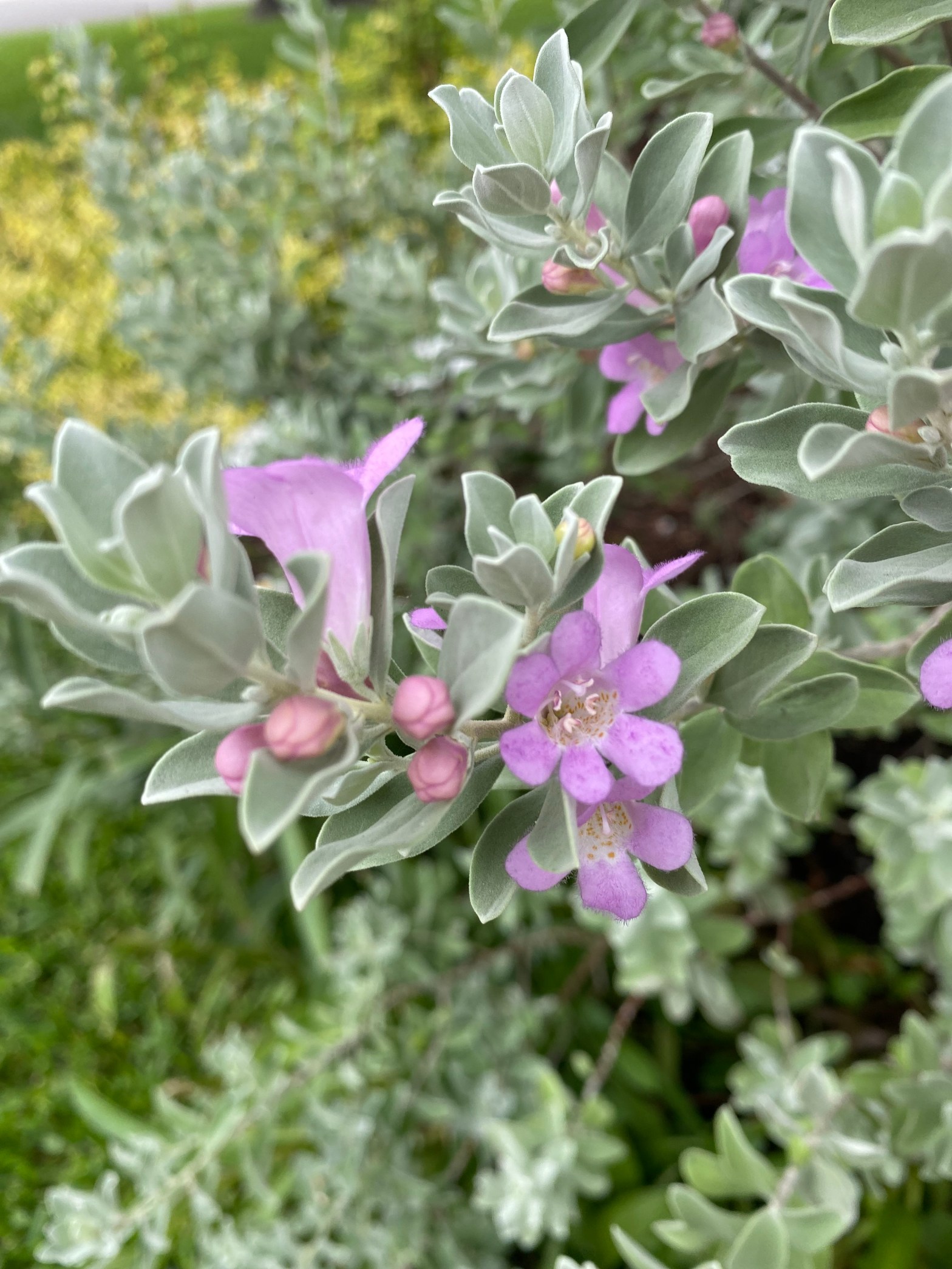
*picture of Texas sage in bloom, a hearty plant that made it through the Feb freeze; the following reflections are selections from last night’s sermon
The ebb and flow of Jewish time speaks in the language of the spirit. What I mean is that it is very possible to feel that within the changing seasons and months there is a deeper wisdom coaxing us along–“remember this”, or “discover that”, or yes, you are experiencing this because, well you are Jewish, and you are human.
Today the Hebrew month of Tammuz ends, and the month of Av begins this evening. Av is the darkest month, unfolding during days that are brilliant with blinding summer light. The month of Av begins this Shabbat, but we have been moving towards Av before it even officially commenced, starting on the 17th day of the month of Tammuz, which fell this year on June 26th.
The 17th of Tammuz is recorded in our tradition as the day Moses broke the tablets when he descended from Mt.Sinai and saw the people Israel dancing around a golden calf. And it is the day the Romans breached the walls of Jerusalem. The 17th of Tammuz is the start of a three-week period leading up to Tisha B’Av, the ninth of Av, when we mark the destructions of the Jerusalem Temples and other traumas befallen our people.
We are now in the middle of the three weeks, which in Hebrew is called bein hametzarim, translated as “within the straits”, or “within the borders.” These borders defined by the lead up to the 9th of Av, suggest some kind of limits and, perhaps, order–amidst loss, amidst life’s uncertainty, amidst shattering pain, amidst trauma, then and now.
Some form and order are essential, especially when our world spins off kilter, when our hearts break, when chaos seems to reign. Within our bein hametzarim, form and order can emerge, when we know that a meal will be delivered to our doorstep. When we say the words of the Kaddish to our best ability with a certain frequency and holding the sturdy prayerbook in our hands as they shake. Within our bein hametzarim, form and order can emerge, when we place a vase of peonies by the window every Friday because peonies were her favorite. When we walk the neighborhood loop each day, even if the thunderclouds are gathering in the sky, because hearing the birdsong is a reminder that we are alive. Bein hametzarim. Narrow straits, limits, and a longing for order.
And yet, the desert journey as recounted in this week’s Torah portion, Masei, speaks to a kind of spontaneous unfolding.
We need that too.
Not in the acute phases of grief or disruption, but along the way, our tradition reminds us that spontaneous unfolding, allowing new, surprising, creative potential to emerge, is not only essential for the soul’s journey, it’s part of our healing.
Rabbi Mordechai HaCohen, from his volume Al HaTorah, wrote: “once the Torah was given it became timeless and cut loose from any one place: every moment is its moment and every place its place.”* In other words, Torah cannot not be bound or set within narrow limits—it was there, unfolding, with each stop of the desert trek, and the Israelites carried it with them as a kind of compass, from the pain of Egypt to the promise of freedom. So too for each of us –we live in bein hametzarim, narrow straits with limits, AND vast, open wonder, unfolding with each stage of our evolving life journey. We need order and boundaries—and we need to disrupt them at the same time.
One take-away from my recent period of sabbatical is that there is a benefit to letting journeys unfold with patience—there was some general order and form to my sabbatical days, however the goal was to be flexible and unrestricted enough to respond in the moment.
I could share a travel itinerary of sabbatical—18 days in Port Ludlow, 10 days on a farm on Marrowstone Island, 5 days in Seattle—but that hardly captures the feeling of Torah unfolding: like loosing a sense of time and place in the nearby old growth forest. Like my parting ritual of picking up shards of glass and ceramic at the base of the Mother tree. It was a practice that began to create form and order to my days, and yet it emerged quite spontaneously.
In retrospect, the gathering of shards with the start of each new day speaks of regrowth, all of it rooted in a magnificent intelligence of the One that invites us to remember to choose life with each breath. Bein hametzarim, amidst our narrow straights, always the possibility of growth, guided by the limitless Tree of Life, our Torah.
Parashat Masei is the concluding Torah portion in the Book of Numbers. We conclude one book and make our way to the next, step by step, stage by stage, and we say—Chazak, chazak v’nitchazek…Be strong, be strong and may we be strengthened. As the Israelites moved through the 42 different stops along their desert itinerary, they evolved as a community and discovered the laws and values that would define the people of Israel into the future. And we too are strengthened by each other—by our legacy of courage and hope, by the Divine presence that guides our steps. Chazak, chazak v’nitchazek…Be strong, be strong and may we be strengthened.
*gratitude to Rabbi Kerry Olitzsky’s commentary of Parashat Masei (myjewishlearning.com)
 Reflections by Rabbi Kim